Friday, 18 September 2020

Rwanda government, scientists introduce disease-resistant cassava varieties to farmers

 BY SAMUEL NABWIISO

Rwandan farmers lack improved cassava varieties resistant to the main cassava diseases; Cassava Brown Streak Disease (CBSD) and Cassava Mosaic Disease (CMD). The diseases have affected cassava productivity, threatening the income and food security in the country.

 “There are two main diseases that attack cassava in Rwanda and the region, CMD and CBSD. The latter poses a serious threat because once cassava is infected with CBSD, root tubers spoil, leaving almost nothing to be consumed by farmers,” said Dr Charles Bucagu, Deputy Director General of Agriculture, Research and Technology Transfer at the Rwanda Agriculture and Animal Resource Development Board (RAB).

The Government of Rwanda has been working with partners to find clean, safe, and productive cassava seeds.  


In partnership with RAB, IITA has been implementing a four-year project since 2017, which introduced new cassava varieties and seed quality management techniques to fight CBSD and CMD.

The CBSD Project implemented various approaches to curb the diseases. The project introduced up to 17 elite clones, with high dual tolerance to CBSD and CMD, each clone with about 200 tissue culture plantlets. Moreover, over 40,841 true cassava seeds were introduced.

“The project introduced both elite clones and biological seed that have directly and positively impacted the genetic diversity for CBSD/CMD dual resistance now and future breeding efforts in Rwanda. Several CBSD/CMD resistant and high-yielding varieties that carry good consumer preference and other end-use traits have been identified for Rwanda,” said Dr Silver Tumwegamire, CBSD Control Project Leader.  

The project also considered local varieties. Thirty selected accessions were sent to Kenyan Plant Health Inspectorate Services for virus cleaning, 19 were returned for integration into the seed system. Ten have already been used together with the new introduced elite clones to generate new breeding populations. Up to 11,261 biological seeds have equally been produced.

IITA has introduced and built the capacity for Semi-Autotrophic Hydroponics at Rubona station in efforts to strengthen quality seed delivery. Two screen houses and five basic seed centers were established.

“Through the project, Rwanda has made gains in terms of resistant elite clones and biological seed, all of which will enable us to identify high yielding cassava seed and resistant varieties. It has also enabled us to make efforts to streamline the cassava seed value chain in Rwanda. Thanks to this project, we now have cassava seed standards to ensure seed quality control for cassava in Rwanda,” said Dr Athanase Nduwumuremyi, Head of the Cassava research and technology transfer program at RAB. 

Cassava is the second most grown crop and the fourth most consumed staple crop in Rwanda, 2018 official data indicate. It is among the priority crops promoted by the government to ensure food security and increased farmer income.


facebook sharing button


Wednesday, 29 July 2020

Uganda gets 5million Euros for Advancing Greening


 BY SAMUEL NABWIISO

The European Union (EU) represented by the European Commission in Uganda and the Government of Uganda through the Global Green Growth Institute (GGGI) have signed a contract today to cooperate on advancing the Greening Uganda’s Urbanization and Industrialization agenda. This project is part of the European Union’s Inclusive Green Economy Uptake Programme (GreenUP) financed under the 11th European Development Fund (EDF) and will be implemented for a 36 months period with a total cost estimated of just under EUR 5mln. The MoU was signed by European Union in Uganda and Ms. Dagmar Zwebe, Country Representative of the GGGI Uganda office.

The overall objective of the GreenUp action is to contribute to the Ugandan transition toward an inclusive, green and competitive low carbon economy with the creation of decent green jobs. Within the framework of this intervention this Project has been designed to support the Government of Uganda (GOU) with their National Development Plan III (NDPIII) commitments for 2020/21-2024/25, and the long term commitments as expressed in the Uganda Green Growth Development Strategy (UGGDS) and Uganda’s Vision 2040. It will directly contribute to greener growth paths to becoming a middle-income country, through the acceleration of investments in green growth pathways


The Projects impact objective is therefore “Uganda achieves strong, inclusive and sustainable economic growth”. The Uganda Vision 2040 specifically highlights industrialization and urbanization as key focal are as it envisions that 60% of Ugandans will live in urban areas by 2040 and therefore, actions of designing, servicing and attracting investments into greening secondary cities will help Uganda to benefit from the economic and social dividends that come with urbanization.

Through a multi- stakeholder process guided by the National Planning Authority (NPA) as the project coordinator the industrial zones of Gulu, Entebbe, Pakwach and Soroti have been identified to receive support from the Project in the development of their Masterplans in a green manner and the identification of potential investment projects. The Project is committed to attract investment commitments for at least 6 projects for these industrial areas to accelerate and green the industrialization process in Uganda. This process will be guided by specific guidelines setting out what a green industrial could look like.

With a similar process the cities of Arua, Gulu, Jinja and Mbarara have been identified by the stakeholders, led by the Ministry of Lands, Housing and Urban Development in close coordination with the NPA, to receive similar support as the industrial zones in the development of their Masterplans and the acceleration of financing in potential (public and private) projects. For the Arua-Pakwach corridor, and for Gulu there will be a joined focus combining both elements to ensure inclusive green growth is accomplished. Overall, the aim is to set the country on a low carbon development pathway, generating green jobs, to reduce the environmental burden and the use of natural resources and to contribute substantially to increasing green investment flows into Uganda.

Increased waste collection and sorting in the Greater Kampala Metropolitan Area (GKMA) is another element of the Project. Guided by the GKMA Waste Management Strategy 2021-2030, two waste sorting and diversion centers will be designed, and investment commitment will be sought for at least one of these sites to support the GKMA commitment of 30% recycling by 2030. Furthermore, business development support will be provided to multiple small and medium enterprises in the waste sector to strengthen their operations and be able to widen their scope and increase their waste recycling or treatment.
All stakeholders involved within this Project including -but not limited to- the Government of Uganda, the EU and GGGI and are strongly committed to support Uganda’s transition toward an inclusive, green and competitive low carbon economy, and especially the sectors as elaborated upon in the UGGDS. This includes making Uganda’s business environment more conducive to inclusive and green investments and improving the environment for investing in Uganda’s economic green transformation and the urbanization and industrialization agenda.


Thursday, 12 March 2020

Develop strong Natural Resources managment strategy, Development partners asks Uganda


BY SAMUEL NABWIISO
Development partners are urging Uganda to come up with a comprehensive integrated forests resources management approach and access to clean energy targeting refugees and the hosting districts across the country.
The partner's from the Food and Agriculture Organization of the United Nations (FAO) and the World Bank notes that due to the influx of refugees in Uganda from her Neighboring Countries such as South Sudan Democratic Republic of Congo, Rwanda and Burundi into  Uganda is fueling the depletion of Country's natural resources such as forests especially in the refugees hosting districts particularly in West Nile, western and south western parts of the country.
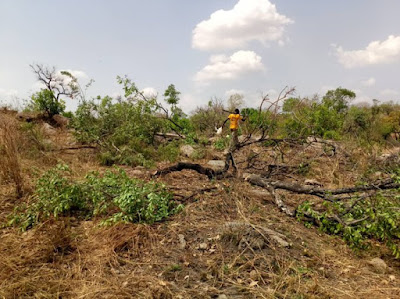
some of the Forest that have been cut down due to the influx of Refugees in some parts of the settlement areas


Speaking during the Launch of two reports that were conducted to assess the natural Resources degradation in refugees impacted areas  in Northern Uganda and the assessment report on forests resources Degradation and interventions Options in Refugees, Hosting areas of Western and Southwestern Uganda, the FAO  Country Representative in Uganda' Antonio Querido,noted that Uganda is losing forests cover at a higher rates especially in the refugees hosting region's thus the need to act so that the depleted natural resources are restored.

"Planning and achieving sustainable forest's and land management in the refugees hosting areas  is crucial to avoid the detrimental environmental Impacts that may occurs due to the biodiversity destruction “He said during the launch of the reports at the protea Hotel in Kampala Recently.

According to Querido, government should implement interventions such as A- forestation, Reforestation and also establish markets oriented multipurpose wood lots that can support sustainable supply's of wood fuel, timbers, building materials and other non wood forest's products.

"As development partners we hope that if such interventions are well implemented by the various Government agencies it can mitigates the detrimental environmental Impacts such as soil erosion, out Blake of diseases, floods that may occurs due the depletion of the biodiversity in the refugees hosting districts and communities across Uganda “He added.
The FAO  Country Representative in Uganda Antonio Querido speaking during the Launch of the Reports


The coverage of the Study, the study was carried out in Western and south Western Uganda alongside Northern Uganda targeting West Nile sub region in Western Uganda, the study was carried out in six settlement areas, namely Kyaka11 in Kyegegwa District, Kyangwali in Kikube District,Rwamwanja in Kamwenge district,alongside other settlements such as Kiryandongo in Kiryandongo district and lastly the Oruchinga settlement in Isingiro District.

From the study it was found that majority of the refugees in the various settlements were depending on biomasses as the primary sources of energy and this has fuelled the highest rate of forest cover and other related biodiversity depletion in the refugees hosting districts and communities in the surveyed areas.

In the study for instance in Kyangwali settlement 75.5,% of the refugees were depending on fire wood while in Kyaka11 settlement charcoal was the major source of energy, and even where the charcoal has been adopted as the major sources of energy, refugees were using traditional Charcoal stove's that are not energy efficient which ends up exposing them to diseases related to the inhalation of smokes.

In the report, the various Governments agencies such as the ministry of Energy, Environment and the office of the Prime Minister were cautioned to promote the usage of improved charcoal stove's especially among the refugees and the hosting communities this can help them to optimize the usage of biomass fuel effectively.

"There's a desire to optimize fuel consumption through the usage of more efficient and modern cooking stoves available on the market.inspite of this several households and refugees are not migrating to improved one's because of the poor flow of information related to the availability of the modern Energy , efficient cooking stoves on the market “Reads part of the Report.

Key findings in the study on the Biodiversity destruction in the refugees settlements and the hosting communities, in the Report, it’s reportedly that in South and South Western Uganda Refugees settlement areas, the study indicates that between 2001 and 2018 total tree covers losses in Kyaka11 and Kyangwali settlements were near 10% as high in both the 5 kilometers and 15 kilometers away buffer zones from the refugees settlement boundaries.

In Kiryandongo settlement areas the areas according to the study recorded a 73% nature forests cover losses between 2001 and 2018 due to the arrival of refugees in the settlement arae.
The magnitude of Refugees in Uganda, according to the information available from the office of the Prime Minister, currently Uganda is hosting about 1.3 million refugees most of them are living in Northern Uganda; Western parts of the Country, such population have exerted pressure on the country’s natural resources.

In the report it's revealed that the total wood demands for cooking in the Northern Refugees settlement camps stood at 345,000 metric tons per year in the 14 Refugees settlement camps Inthe District’s of Arua ,Yumbe,Moyo, Adjuman and Lamwo and in the south and Western Uganda Refugees settlement camps the demands for wood fuel is at 475,000 metric tons of wood fuel.

Commenting on the report, the World Bank country manager in Uganda.TonyThompson challenged the Government of Uganda to implement programs that can address the issues highlighted in the report, urging that this will help Uganda to over comes Environmental related catastrophist such as Climate change, Land degradation's.

This Work is of strategic importance to both the government of Uganda and the development partners especially the World Bank strategic goals. we urges the government of Uganda to include issues related to Refugees in natural resources management in the upcoming National Development plan phase111 Which the government is developing this will play big roles towards the protection of the country’s natural resources in the refugees hosting districts and communities “He said 

Tuesday, 3 December 2019

Unjust Land Laws Driving Inequality in Uganda, and Biodiversity Degradation


BY Sharon Kyatusiimire
A report by Oxfam Uganda has shown that more Ugandans especially the rural poor, women and the youths are increasingly losing their rights overland, a thing that is pushing them further into poverty and hence worsening inequality between the rich and the poor.

According to the report titled 'Locked Out', the poor population, young people and women most of whom live in rural areas has been locked out from enjoying their land rights.Land disputes according to the report stem from the post-colonial land laws and the available policies have failed to effectively deal with perpetual land questions.

Speaking at the official launch that happened at Mestil Hotel in Kampala on recently, the state Minister for Lands, Persis Namuganza said because of the increasing population, this has exerts much pressure on land  and other Biodiversity’s resources in the Country   which has resulted into land disputes and Environmental degradation.
Minister Namuganza making  speech during the Launch of the Report 

The Minister explained that those with less power on lands across the country have been forced to encroach on gazetted Biodiversity such Forest’s, wetlands and in turn this has big negative impact on the country’s Environment.

“Some of those people you see encroaching on wetlands, destroying the country’s forest are there because of inequality in the land ownership that is why we are experiencing  some floods in some parts of the country because of Land Injustices which most people especially the rural poor are expiring” She explained.  
   
She added that the Government is doing everything to tighten the Land Laws to offer protection for the vulnerable groups.

"At the moment we have over 43m people, by 2030, the population will be 50m and 100m by 2050. The land of Uganda has remained constant hence the need to put in place laws and regulations that will ensure effective use of this limited land for all Ugandans," she said

The Oxfam Country Director Edward Mwebaze said that there’s a huge gap between the poor and the rich according to the recent researches done by the organisation in 2017.

“The poor are marginalised and many were locked up off their land, paid less or payment delayed. We invite the authorities to come up with clear solutions to deal with the situation,” Mwebaze said.
Between 1996 and 2012 the richest 10% of the population increased their share of national income from 29.9% to 35.7%. On the contrary, the share of the poorest 10% decreased from 3.2% to 2.5%.

Presenting highlights of the report, Dr.Fred Muhumuza from Makerere University  said that people providing paid agricultural labor and people in subsistence farming are more likely to be poor than those whose main income is commercial farming or other non-agricultural enterprise.
Dr. Fred Muhumuza  the Brain behind the Report 
“The use of land also has an impact on households that are not directly dependent on land-based activities. This is through the production of food, export revenues, and industrial production that influence the price levels and value of real income,” Muhumuza said.

He added that the most frequent causes of disputes around land relate to boundaries, rights of way or access (36%), ownership or use (25%), land grabbing (22%) and missing or unclear land titles (4%).

“The inadequacy of land dispute resolution mechanisms is a major contributor to inequality,” he said, adding: “Trust in dispute resolution mechanisms is undermined by interventions of the Office of the President in cases that are already in court.”

Monday, 11 November 2019

Anew Curriculum to boost EAC Hospitality Industry Launched


BY SAMUEL NABWIISO.
The hospitality industry (tourism) in Uganda has got yet another boost from the Booking.Com and EyeOpeneraWorks towards skills development of youth in the East African region.

As East Africa continues to remain the hub for tourists in the African continent, from around the world, it is imperative that those in the field of tourism are equipped with the necessary skills to handle the visitors.

Throughout the continent new hotels and lodges are being built every single day and more and more tourist activities take place, but research has indicated that the staffs in these hotels still, doesn’t match the global standards acceptable to handling foreign visitors.

According to Melodi Tamarzians, the Mango Tree Creative Director, who are implementing for the Curriculum said the programm aimed at  preparing   students for internships and ultimately jobs in these local hotels, lodges, restaurants, and tourist sites.
Martijn Harlaar from the EyeOpenerWorks
with Microphone speaking during the Launch of the programme 

“It is designed to prepare them for a future in the emerging world around them,” she told the press during the Ukarimu Hospitality launch held at the Design Hub, Mango Tree in Kampala on recently.

The curriculum is based on principles of active learning and is a combination of hard and soft skills to inspire young adults with little education and limited options.

Jean Charles de Bievre, the Global Commercial Excellence Manager at Booking.com said the unique course will help them to create skills to be a good employee, how to be a productive member of a team, how to identify a place for themselves in the industry, and how they can set personal goals to prepare for the future. 

Ukarimu is the first open-source curriculum for tourism and hospitality training in Africa.
It is initiated by Mango Tree and EyeOpenerWorks in partnership with a number of grassroots hospitality training institutes, such as the Karamoja Tourism Training Academy and the Rwenzori Tourism Academy in Uganda, and the other tourism training institutes in Kenya, Tanzania, and South Africa.

Martijn Harlaar from the EyeOpenerWorks noted that Youth unemployment is a big problem all over Africa and yet, tourism is growing rapidly.

“Tourism can play an important role by providing meaningful jobs to local youth. Hotels and lodges are interested in employing local youth, but in our  own investigation found found that 9 out of 11 lodges state they are unhappy with the current skills of graduates from hospitality training institutes” He explained

“Ukarimu is freely available for anyone with an interest in training young people in tourism and hospitality (hotels and lodges, NGOs, governments,” he said during the launch.

Ukarimu is an open-source curriculum for tourism and hospitality training, based on principles of active learning and promoting practical sessions. It is the first of its kind in Africa. 

Through short, practical training, students are taught in technical skills, soft skills on customer care and professionalism learn how to operate in the industry, and how to build a career.

Ukarimu is implemented by Mango Tree (MT) and EyeOpenerWorks (EOW), through a process of human-centered design and co-creation.It is developed in collaboration with the Rwenzori Tourism Academy, the Karamoja Tourism Academy and training institutes in Kenya, Tanzania and South Africa. Ukarimu is funded by the sustainability team of Booking.com


Airtel Uganda Launches New Internet Solution, SME,s to benefit


BY SAMUEL NABWIISO
Uganda’s small and Medium Enterprises that have been spending highly on expensive Internet will have reason to smile after Airtel Uganda’s launched recently  a new Internet solution targeting SME, s and Homes.
The new Solution Airtel Broad band outdoor Internet solution will offer uninterrupted Internet at affordable cost compare to the current solution which the various telecoms are offering to the internet users.
According to the Airtel Uganda Managing  Manager V.G. Somasekhar,  the Airtel Broad Band  Out door  which is fixed Internet devices has the ability  to connect  32 internet powered  devices this makes it conducive to  Homes and SME,s.
Airtel Uganda Managing Director Somasekhar Handing over new brand Airtel Braod Band Devices to the Minister Michael Werikhe Kafabusa.
“The solution is ideal for businesses particularly SMEs that need a reliable, fast internet for uninterrupted operations adding that it as well addresses the need for the smart home allowing simultaneous connections for streaming online content, e-entertainment; while still acting as a WiFi Router for the entire house at the same capped monthly cost” Somasekhar explained during the Launch at the Airtel Offices.

Commenting on the affordability of the solution, the Airtel officer noted that Airtel Broad Band is affordable to the general public especially to the SME,s and it has an associated  Incentives on it to the customers.
  “The solution offers the best internet experience at the most affordable rate of less than Shs2,000 per GB, and the unit attracts a one-off entry cost of Shs280,000 inclusive of a 51GB of Data valid for 30 days, free installation and device maintenance” He added
Launching the solution, the State Minister for Trade in the Ministry of Trade Industries and Cooperatives, Michael Werikhe Kafabusa applauded Airtel for coming up with such solution which he said it will aid the Ugandan Business Communities.
 “Communication plays big role in supporting trade in Uganda our trader are facing challenges associated with high cost of Internet but with the coming up of Airtel Broad Band Internet solution this will lower the cost majority SME,s have been incurring  on Internet” He said
He added by explaining that  Ugandan traders like their counterparts in other African countries are embracing online trading but this cannot be rolled out with the high cost of Internet  thus the need for the private sector to come up with cheap products that can support Ugandan trade to embrace online  shopping and marketing.
 Commenting on behalf of the SME,s Isa Ssekito the Public Relations office for Kampala City traders Association said with the Launch of the solution this will lower the cost of doing Business by the SME,s in the Country.
Isa Ssekito of KACITA receiving new Broad Band Kit  from the Aitel Uganda Managing Director  
The Airtel Broad Band Internet solution will be first piloted in the greater Kampala covering the areas of Kampala city, Entebbe and some parts of Mukono; however Airtel promised the network to be extended to other parts of the country in few months to come.


Wednesday, 6 November 2019

LVBC AND UNEP team discussed adapting to climate project implementation

 Source LVBC
A team from the United Environment Programme (UNEP) and Lake Victoria Basin Commission (LVBC) recently held discussions centered on progress of implementation for Adapting to Climate Change in Lake Victoria Basin (ACC-LVB) Project coordinated in 5 East African Community (EAC) Partner States.
The meeting held at LVBC Headquarters, Kisumu, Kenya from 22nd-23rd October 2019 aimed at discussing project implementation progress, existing challenges and drawing momentum to fast-track the implementation moving forward.

LVBC Executive Secretary Dr. Ally Said Matano referred to the project as catalytic and responsive to existing climatic challenges in Lake Victoria Basin. LVBC Executive Secretary cited weather extremes such as floods after drought in EAC Partner States as practical examples of relevance of project interventions on adaptation climate change risks and vulnerabilities.
Dr. Ally Said Matano  inthe Midle with neck tie  posing in group photo with UNEP delegates 
He lauded the existing mutual partnership between UNEP and LVBC as evidenced by the present project on adaption to climate change and other foreseeable partnership opportunities in the future.
He guided the technical project management and oversight team to approach the project implementation with an end in mind because it guarantees clarity towards achieving the project intended outcomes and impacts.

Essey Daniel, Programme Officer from UNEP shared with participants the uniqueness of the project, its responsiveness to existing climate change vulnerabilities and risks at regional, national and community levels of East African Community Partner States.

 He acknowledged the complexities of the project specifically being the first of its kind in Lake Victoria Basin region of the East African Community. Examples cited as complexities included differences in levels in terms of mainstreaming adaptation, mitigation and climate resilience in policies, plans, priorities of EAC Partner States and transboundary nature of the project.

Essey underscored that whereas the project has specific activities, project management team should also prioritize existing peoples’ strategies of adapting to climate change at local levels. He also acknowledged the catalytic nature of the project and heralded future partnerships between LVBC and UNEP building on potential best practices from the present project. 

The meeting discussed LVBC governance structure, project implementation status and strategies for fast-tracking implementation strategies for project activities, procurement and finance components of the projects among others.

Closing the meeting, LVBC Executive Secretary, Dr. Ally-Said Matano noted that meeting acted as an induction for some new members joining the project and reviewing implementation status. He reiterated the good political will, LVBC stakeholders convening advantage and complementary expertise which will contribute to the realization of the project objectives.  

Overall, Adapting to Climate Change in Lake Victoria Basin (ACC-LVB) Project aims at reducing vulnerability to the negative effects of climate change in Lake Victoria Basin.  Key project outcomes are institutional and technical strengthening, timely sharing of climate change related information with national policy-makers, technical officers and local communities, reduced community vulnerabilities, enhanced regional climate change resilience and improved knowledge sharing for effective decision-making in the Lake Victoria Basin
.
Participants to the meeting were Eng Hilda Pius Luoga, Acting Deputy Executive Secretary for Programmes and Projects for Lake Victoria and Projects Development Officer, Adapting to Climate Change in Lake Victoria Basin Manager, Dr. Masinde Bwire, and other Project teams from Lake Victoria Basin, among others.